
Getting Married In Spain
Civil vs. Symbolic Ceremony in Spain
Belka Destination Weddings plans both civil and symbolic ceremonies for couples marrying in Valencia & Surroundings and Costa Blanca North, Spain. This comparison lays out what each ceremony type actually involves — legally, logistically, and on the day — so English- and Russian-speaking couples can choose the right structure before booking a venue.
The Short Answer
A civil ceremony in Spain is legally binding on the day itself but must follow the Spanish Civil Registry’s residency and paperwork requirements, which typically take several months and restrict where the ceremony can be held. A symbolic ceremony can be held at almost any venue in Valencia or Costa Blanca North, with no residency requirement, while the couple completes the legal marriage separately — usually a short civil formality in their home country before or after travelling to Spain. Most of Belka’s international couples choose the symbolic route in Spain paired with a civil ceremony at home, since it removes the paperwork timeline as a venue constraint.
At A Glance
Civil vs. Symbolic, side by side.
|
Criterion |
Civil Ceremony |
Symbolic Ceremony |
|---|---|---|
|
Legal Validity |
Legally binding in Spain on the day, recognized immediately in the couple’s home country via consular registration. |
Not legally binding on its own — legal marriage is completed separately, usually before or after the trip. |
|
Venue Flexibility |
Restricted to registered civil venues or an authorized officiant’s approved locations. |
Any venue — villa, beach, finca, historic building — with no registry restrictions. |
|
Timeline & Paperwork |
Typically 3–6 months of document preparation, translation, and residency/notice requirements. |
No residency or notice period; paperwork is handled through the couple’s home civil process on their own schedule. |
|
Guest Experience |
Formal, procedural tone set by the officiant and registry format. |
Fully personalized structure, vows, language, and rituals chosen with the couple. |
|
Multilingual Ceremony |
Conducted in Spanish, with a sworn translator required for non-Spanish-speaking couples. |
Can be conducted in English, Russian, Spanish, or a mix, by an officiant who works across languages. |
|
Cost |
Registry and translation/interpreter fees, plus officiant costs where applicable. |
Officiant fee only; often lower overall since no sworn translation is required. |
Legal Validity
Civil Ceremony
A civil ceremony performed by an authorized Spanish official or judge is legally binding the moment it’s registered — no separate legal step required afterward, and the marriage is recognized abroad through standard consular registration.
Symbolic Ceremony
A symbolic ceremony carries no legal weight in Spain by itself. Couples remain legally unmarried until they complete a civil ceremony elsewhere — commonly a short registry appointment at home, either before or after the Spain celebration.
.
Venue Flexibility
Civil Ceremony
Must take place at a registered civil venue — typically a town hall (ayuntamiento) or a location specifically authorized by the local registry — which rules out most private villas, beach clubs, and fincas as the legal ceremony site.
Symbolic Ceremony
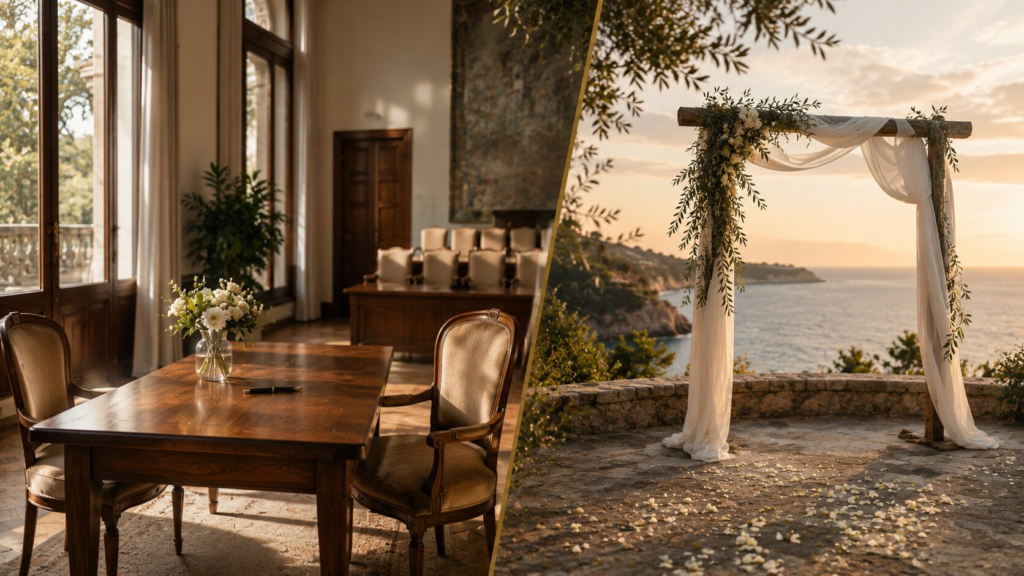
Can be held anywhere the couple books — a clifftop terrace in Costa Blanca North, a Modernist palace in Valencia, a countryside finca — since there’s no registry requirement dictating the location.
.
Timeline & Paperwork
Civil Ceremony
Requires translated and apostilled documents, a Certificate of No Impediment, and — for many nationalities — a residency or notice period at the local registry, generally starting the process 3–6 months out.
Symbolic Ceremony
No Spanish paperwork required for the ceremony itself. The couple’s legal marriage follows their home country’s own process and timeline, entirely decoupled from the Spain wedding-planning calendar.
.
Guest Experience
Civil Ceremony
Set by the registry’s format and timing rather than the couple — a short, procedural appointment that guests observe rather than fully participate in, with limited room for personal touches.
Symbolic Ceremony
Fully personalized: vows, ritual elements (sand ceremonies, ribbon-tying, letter readings), seating, and pacing are all built around the couple, making it the more immersive experience for guests.
.
Multilingual Ceremony
Civil Ceremony
Conducted in Spanish by law, with a certified sworn interpreter required if the couple doesn’t speak Spanish — an added formal layer, and a cost, that most international couples don’t anticipate.
Symbolic Ceremony
An experienced officiant can run the ceremony in English, Russian, or Spanish — or blend languages — which matters when the couple, their families, and their guests don’t all share one language.
.
Cost
Civil Ceremony
Registry fees are modest, but sworn translation and interpreter costs for non-Spanish-speaking couples add up, along with any officiant fee if held outside the standard town hall slot.
Symbolic Ceremony
Generally the lower-cost option for the Spain portion, since there’s no sworn translation requirement — the main cost is the officiant fee, which varies by language and ceremony complexity.
.
Decision Helper
Which one fits your wedding?
Choose a Civil Ceremony in Spain if —
◈ You want the legal marriage and the celebration to happen on the same day, in the same country.
◈ You’re comfortable starting document preparation 3–6 months in advance.
◈ A town-hall or registry-authorized setting fits your vision for the ceremony itself.
Choose a Symbolic Ceremony if —
◈ You want full freedom over venue, language, and ceremony structure.
◈ You’d rather complete the legal paperwork quietly at home, on your own timeline.
◈ Your guest list is multilingual and you want the ceremony conducted accordingly.
Common Questions
